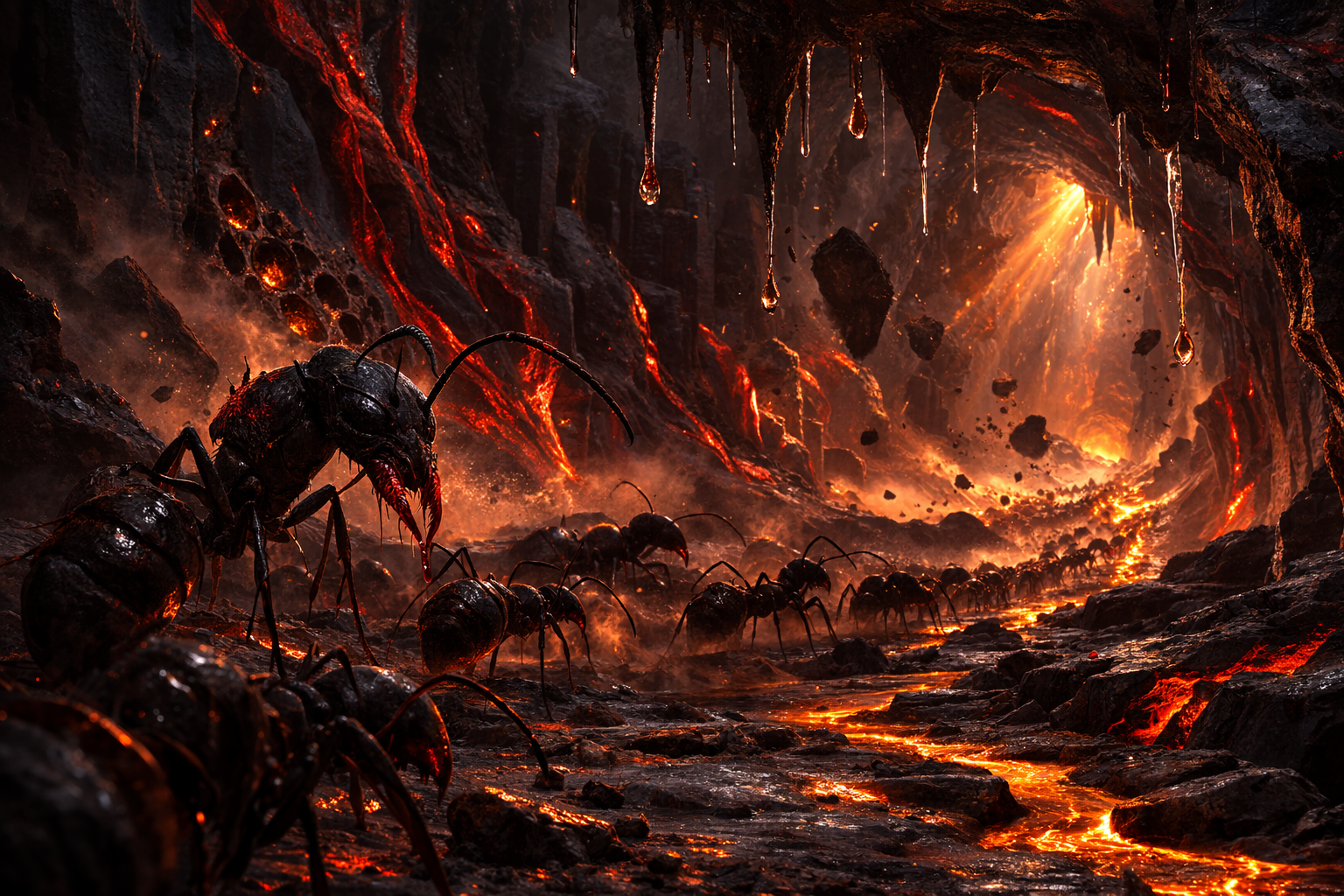
In the underground kingdom, a queen is born alone. She is given neither escort, nor time, nor pity. She is given a naked question: will she survive before the first hunger?
Her first hole was an open wound in the black sand of the Kingdom of Bel-Azh. She slipped in, numb, the metallic smell of her own birth clinging to her antennae. The earth resisted. Too dry. Too compact. She dug anyway.
A tiny collapse closed the entrance behind her.
She remained motionless.
Wait or flee? Dig deeper or die there?
Something vibrated in the upper layer. Not a predator. Not yet. Just the world that remembered it was hostile.
She continued.
But as she dug deeper, a thought crossed her mind, fleeting and irritating:
What if I read the ground wrong?
She chased the idea away.
A queen does not doubt the signs.
She digs.
But the question remained, stuck under the shell.
Further on, the earth changed its taste. It became redder, denser, streaked with mineral veins which cut the galleries like bones in fossil flesh. The old queens called this place Bel-Azh, the womb that does not close, a kingdom so vast that it swallowed legends. It was said to retain the smells of extinct colonies long after they were gone. Kharna felt this memory on her antennae: a smell of ancient roads, forgotten battles and queens that no one named anymore.
It didn't come from those old queens. She remembered nothing, except a blinding light, a beating of wings, a shock against the earth. Her birth had not been a song, but a fall. She had landed alone, and this solitude had immediately taken the form of an order. Bury. Become invisible. Live long enough to understand.
The first days were simple and excruciating. The tunnel, a room. The room, a prison. Then, like an internal storm, the eggs came. First one, then ten, then a hundred. A creamy white flood that devoured her space and her peace. She laid eggs, and the more she laid eggs, the more her nest shrank like a jaw closing. The air was getting thick. The earth vibrated with beings it had not asked for.
She tried to freeze, to go into a deep sleep, to strangle the instinct. Her body does not obey. Each egg that fell was a stark reminder: she no longer belonged to herself. Kharna tried to stop them.
When it finally stopped, she stood motionless among the pulsing packages, her throat tight. She thought about destroying them, eating them, surviving by erasing them. Then another thought froze her: what if she was just a meal for what was going to come out of her?
She found herself counting her breaths, as if the cadence could calm the panic. With each breath, the smell of the eggs changed, sometimes sweet, sometimes sour, sometimes metallic. She did not yet know how to distinguish the living from the dead, strength from weakness. But she knew how to recognize fear. She carried it with her like a second shell.
Hunger gripped her stomach. She had hardly eaten since birth, saving every minute to dig. Her body demanded rest that she had no right to grant. Each egg was a future need. Every need was a threat. At night she dreamed that a white army devoured her wings.
She woke up at dawn, her chest trembling, and found the simplest solution in the world. Enlarge. Flee your own work. Dig a longer tunnel, dig a wider gallery, carry your eggs one by one towards the open space.
When the large room was ready, she transported the eggs there, then collapsed at the foot of a dry root which served as a bed. The kingdom was silent. One could believe that the danger had passed.
Before sleeping, she rubbed her antennae against the walls to lay down her track. A tiny thread of scent, a promise that the place was hers. It was a simple, almost childish gesture, but it gave the galleries a beginning of coherence. A soft voice woke her from sleep.
— Hello, Queen. We await your instructions.
Another ant stood there, identical to it but without wings, smaller, livelier. Her body was pale brown, her antennae black like the night of the galleries. It had long, powerful legs, designed for the earth. Kharna felt a surge of jealousy as instinctive as a bite. Kharna sat up suddenly.
— Who are you? she hissed. What are you doing here?
— My name is Siltis, my Queen, said the worker with the pale brown thorax and black antennae. I was born to lead your workers.
— Your daughters, replied Siltis with a calm that bordered on insolence.
— What if I don't give orders?
— So they will dig anyway. They will dig until they die. A colony without direction devours itself.
She hadn't wanted an empire, but the earth had just given her a responsibility. She could refuse it and watch her daughters get lost. Or accept it and carry each of their losses in their own flesh. Kharna felt the weight of this sentence.
— I'm not Queen, says Kharna. It's a role, not my name.
— Then I will say your name when the dust forgets it, replied Siltis. But today, your workers need a queen. On the ground, clumps of sand and clay were already piling up. A smell of effort hung in the air. The further she advanced, the more a buzzing intensified, a friction of antennae, a nervous chorus. Kharna followed her into the tunnel she had dug the day before.
When she walked through the entrance to the gallery, the vision stuck with her. Thousands of workers crowded together, all similar to Siltis, brown antennae, rigid waiting. A brute force stretched out before her, docile, hungry for orders.
It wasn't just an army. It was a multiplied mirror of herself, a living extension of her will. If she was wrong, they would fall. If she hesitated, they would hesitate. The empire that she had not chosen already looked upon her as destiny. Kharna felt dizzy.
— So, Kharna, what do you want from them?
She inhaled. Power is brutal because it forces people to decide quickly.
— Water. Food. Immediately. Dig tunnels to find water, build a warehouse to store it. Make another warehouse for food. Separate the meat from the leaves. I refuse mixed flavors.
— And the expelled land? asked Siltis.
— Stack it in the dead galleries. Let it serve as a wall. Let it serve as a trap. We will not leave our roads open as invitations.
The ground vibrated under their long legs. The earth was rain in their mandibles. The empire began to exist. Kharna retired to her room to breathe. The excitement turned into dizziness. She had questions that no worker could answer for her. What to do with the expelled soil? Where to find enough food? How to defend a still fragile colony? And above all, would it ever come out? Siltis tilted her antennae, gave a series of clicking sounds, and the workers dispersed into silent columns. In the depths, an unknown smell sometimes slipped through her tunnels, an acidic trace that did not come from her. Other kingdoms existed, and their appetite knew no bounds.
The Kingdom of Bel-Azh was just a handful of galleries in an endless world. Around her, other kingdoms, other queens, other beasts. She had just discovered the empire she carried, and an even more terrible truth: alone, she would die. Together, perhaps.
The following day, the first larvae broke their envelope. The sound was almost imperceptible, a wet crack, but it passed through Kharna's body like a shock. Instinct told her to approach it. She leaned over the first, tiny, pale, limp, unable to stand up straight. She smelled her new, uneventful scent, a scent that still contained neither fear nor discipline.
She stood there for a long time, surrounded by trembling chaos, watching her daughters learn about gravity. Some crawled randomly, others remained motionless until a worker came and touched them to start them up again. A larva that was too slow was pushed back into the shadows. Kharna brought her closer to the center without knowing why. She didn't yet know whether to save the weak or sort them. She only knew that seeing them move, her loneliness lost a little of its weight.
A little later, when the spawning chamber was stabilized, Siltis returned with three young commanders already trained on the active corridors of the colony. She introduced them to Kharna. Mirel, the first, stocky and silent, kept her eyes on the exits. The second, longer, with nervous antennae and quick gaze, was called Yenna. The third, Ashra, was already limping slightly from an old gallery chute, but its smell conveyed a rare clarity.
— These are the basic relays, called Siltis. If you speak, they can transform your words into gestures.
They were born from her, and yet they already seemed more accustomed to the ground than her. Kharna looked at them one by one.
Mirel left first. She hardly spoke. She touched three workers, placed them in a triangle around a pool of larvae, then rotated them with a simple flick of her antenna. When a novice hesitated, Mirel brought her back with a blow from the chest, without unnecessary brutality, but without tenderness.
Yenna did the opposite. She chose a corridor cluttered with rubble, engaged a line of conveyor belts and imposed a short vocal rhythm to cross without a traffic jam. Each mistake was corrected out loud, not to humiliate, but to prevent it from being repeated. In less than a quarter of waking, the passage became smooth.
Ashra took a dead section, buried sand traps there and set up olfactory markers so fine that Kharna herself had to stop to read them. When everything was ready, Ashra took a team through this corridor as if in a test. A worker triggered a trap. Ashra didn't blink.
— If one of us can fall for it, so can the enemy.
Kharna then understood that her role was not to make each gesture, but to make the gestures compatible.
— GOOD. We are going to write rules.
The word write made Siltis shiver.
— In smell?
— In smell, in voice, in pain if necessary.
The commanders looked at her as if she had just broken a tradition that they did not yet have. Kharna had three laws engraved in the main galleries: food comes before pride, larvae before reserves, and any order can be challenged if the ground says otherwise.
— A colony without a counter-order dies of its certainties, added Kharna.
The first week took the form of a war against the invisible. It was necessary to open water routes without flooding the rooms. It was necessary to ventilate the nurseries without inviting air predators. It was necessary to feed the larvae without exhausting the conveyors which brought in the meat. Each choice solved one problem by creating another.
Mirel reported the first source: a trickle of water seeping from a high fissure. The flow was low but clean. Kharna decided not to send the strongest, but the most constant, those who could make a hundred round trips without breaking the pace. Yenna protested.
— The stronger ones will fill faster.
— They will get tired more quickly too, replied Kharna. I want teams that know how to last.
The same evening, a section of wall gave way near the source. Two conveyors were buried up to their chests. The strongest could have come out, the most constant stayed and dug until they were freed. Yenna no longer discussed the decision.
As for food, Ashra imposed a simple sorting doctrine: fresh meat in the east, dry meat in the north, vegetables in the south, never mixing in the same rooms. A novice tried to save time by merging two stocks. Three days later, black mold spread to an entire reserve. Kharna had the room emptied, the walls burned with hot salt, and kept the novice with her during the entire cleaning.
The novice wept silently. Kharna made her repeat, in front of a witness, the exact chain that had led to the error. It wasn't cruelty. It was an autopsy of the future.
The nights were worse than the days. When the colony slowed down, the ancient smells of Bel-Azh rose from deep strata. Kharna thought it recognized words that did not exist. Routes took shape in her head, then disappeared as soon as she wanted to follow them. Sometimes she woke up sure she had heard footsteps in a boarded-up gallery. One night, she went there alone.
The corridor was narrow, damp, saturated with the smell of rust. Ashra tags stopped at the entrance. Beyond that, nothing. Kharna nevertheless moved forward. Ten antenna lengths away, she found a mark that no one in her colony had engraved: an acid trace, thin, curved, almost elegant. She didn't understand the sign, but she understood the message. Someone had come, observed, then left quietly. At the succession council, she asked the question bluntly.
— Who can trace this?
No one answered at first. Then Siltis said a name that Kharna had never heard. At the entrance to the rooms, the voices lowered to a whisper, — Rheva.
The word fell like a stone.
— Is she a queen?
Mirel completed:
— They don't always strike to kill. They strike to distort. They affect the slopes, the reserves, the relays. They make a colony foreign to itself.
— So we become more difficult to deform.
Kharna ordered three things. First, no single route to a vital resource: each flow would have a mirror route. Then, each order would be repeated through two channels, smell and voice, to resist tampering. Finally, any unknown marks would be copied onto a clay tablet and transmitted to the command chamber before being erased. Yenna added a fourth measure without waiting for authorization: mobile sentries in pairs, never alone, never on the same schedule two nights in a row. Kharna validated. The following weeks were a school of fatigue.
The colony grew quickly. Too fast. The more the galleries extended, the more the distance between the crises increased. A decision taken in the east came to the north too late. An alert launched in the south went back to the center with words that were already worn out. The errors were no longer local: they traveled. Siltis proposed creating permanent relays, points where orders would be reformulated before being executed.
— I want to add filters between your voice and panic.
Kharna observed the traffic in the central gallery. A conveyor jostled a guard; the guard responded, the line split, three bags fell, two larvae were moved too quickly. All this in seconds.
— Do it.
The relay system changed the colony more than any battle. Ashra trained information conveyors capable of translating an order into a precise sequence: who moves, when, where, and what to abandon if it fails. Mirel imposed a rule of closure: each execution had to be followed by a short report, without justification, only the facts. Yenna created break signals, a way of announcing that an order was no longer viable without humiliating the person who had given it. Kharna understood that she was no longer just a queen of flesh. She became the guardian of a language.
One morning, a conveyor limped into the command room. She came from the meat sector. Her chest bore fine cuts, not deep enough to kill, sharp enough to send a message.
— They follow us.
They found skid marks near the warehouse, segments of foreign shell, and this unmistakable smell: cold acid, almost clean, as if the violence had been washed away. Mirel wanted to track down immediately. Kharna sent Mirel with a light unit.
— If we let them come back, they will take over our habits.
Yenna opposed it.
— If we run, they will take our breath.
Kharna let them look at each other to the point of conflict, then decided.
— We don't run. We give them a door. Just one. And we observe it.
They set up a false weak point near the meat reserves: a deliberately imperfect partition, conspicuous markers, a blind spot that was too obvious. Behind, Ashra hid two closing teams and a recovery unit. The goal was not to win. The goal was to see how the enemy thought. The first night, nothing. The second, light vibrations. The third, a movement of air, then a silence so clear that it seemed like a presence. At dawn, the blind spot had disappeared. Someone had gone around it without entering.
— They test our patience, says Yenna.
— Then we will test their hunger, replied Kharna.
She had some of the meat moved to a deeper chamber, and intentionally left grease smells in the old warehouse. A lying lead. Mirel gritted her mandibles.
— If our own teams make a mistake, we'll lose more than we protect.
— Then we will check each route twice, says Kharna. I prefer conscious slowness to blind speed.
That night, Kharna slept little. She dreamed of a corridor that folded in on itself like a tongue. At each fork, a version of itself gave a different order. The workers all obeyed, and the colony split open. She woke up with her mandibles sore from squeezing too hard. In the morning, Siltis was waiting for her.
— You no longer hold the center alone.
It wasn't a criticism. It was a diagnosis.
— So share the load before it breaks you.
She retained the vital arbitrations. The rest was distributed. The decision made the elders murmur. Kharna agreed to delegate part of the direct command to a restricted circle: Siltis for the flows, Mirel for the front, Yenna for the maps, Ashra for the traps and internal security.
— A queen who shares loses her edge, said one.
The days passed. Bel-Azh took on a more stable, almost breathable form. The larvae were growing. The main corridors were consolidated. Reserves were rising. Even the chamber of the dead, still small, had received her first rules: name, cause, date, location. Kharna wanted each loss to leave a legible trace. No disappearance without memory. She also began training the younger commanders in a rule that no one liked to hear.
— A good decision is not one that avoids pain. She is the one who chooses where the pain falls.
Some lowered their heads. Others looked at her as if she robbed them of the illusion of a clean war. One evening, Teren, a little guard with a narrow chest, legs too long for her age and a left antenna shortened by one segment, asked.
— And you, who chooses where your pain falls?
She looked at her blackened legs, her cut antennae, the bite marks on her chest. Kharna had no immediate response.
— For the moment, no one. Under the tags, Kharna, she felt an unexpected pride. Siltis barely smiled.
They might have believed that this emerging maturity was enough. Bel-Azh proved them wrong from the next shift.
Unexpected runoff passed through the upper levels after surface rain. The water did not come down in a clear cascade; it infiltrated in trickles, by the dozens, then hundreds, and transformed the oldest corridors into mud traps. The convoys slipped. The olfactory beacons were diluted. Two storage rooms became unusable in less than an hour. Yenna arrived at the center with soggy cards.
— East roads are dead for the night. If we insist, we lose the teams in the soft junctions.
Mirel, still covered in dust, placed her paw on the tablet.
— The western roads are longer. We will lose flow.
— We will lose everything if we keep the east, decided Kharna. West now. Is sealed until dry.
The transition was brutal. Convoys formed on short routes had to urgently learn a curved, colder route, crossed by air pockets where voices were distorted. Ashra placed markers every twenty steps. Siltis doubled the larvae carriers. Kharna herself traveled the west corridor against the flow to correct the bottlenecks. In the middle of the third round trip, a young conveyor collapsed, her legs paralyzed by the cold. The flow behind her compressed instantly. Kharna picked her up by force, entrusted her to a nurse and shouted a necessary order, which she knew was unpopular.
— We lighten the bags. No unnecessary pride. I want arrivals, not martyrs.
Some elders grumbled silently, humiliated to return with partial loads. In the evening, when the accounts were done, the reserve had diminished less quickly than expected. The decision had saved the pace.
It was the first time that Kharna understood what a logistical victory was: no one applauded it, no one told about it, but the kingdom passed the night without acute hunger. The next problem came with the voices.
With the extension of the galleries, oral orders suffered distortions. A counter-order sent as "close the north route" sometimes came back as "force the north route" after three relays. A swallowed consonant, a misplaced intonation, and an entire section fell into error. Yenna proposed reducing the operational vocabulary.
— We can't stop the walls from eating syllables. We can choose words that survive.
For two days, they rewrote the war lexicon of Bel-Azh. No more long sentences. More nuances in the emergency. Each order became a short block, tested at different distances. Mirel first made fun of this “mouth school”. Then she found that a charge could be redirected without panic in three crisp sounds. Kharna validated the reform and added a constraint.
— Any contact order must contain a fallback clause. Always.
Yenna noted the rule with a curt gesture.
Mirel did not respond.
A surface section returned with a large supply of protein and demanded a priority share of the rations, arguing that their losses were heavier. The water sections refused. The nurses protested. The debate caught fire in the middle of the central gallery and quickly slid towards an old poison: merit. Mirel defended the hunters. Yenna defended the conveyors. Both were right on their numbers and wrong on their tone. Kharna let them talk until words stopped producing facts. Then she got up.
— We will not nurture bravery. We will feed the function.
Silence fell suddenly.
A guard protested.
— Hunters die more!
— Yes, replied Kharna. And without water, they die even faster. Without nurses, they die for nothing. Without transport, they do not hunt. No one survives alone here.
— You just turned a resentment into a procedure.
— It's not elegant.
— Do you think we'll find him this time?
— I believe we can make it. Crumb by crumb.
She wasn't a shock stiff. She was an observer, thin, fast, covered in a powder that blurred her original scent. She was intercepted near a secondary relay, memorizing the passage cycles. Mirel wanted to run it immediately.
— Nothing is gained by keeping this alive.
Yenna opposed it.
Kharna observed the infiltrator.
— What's your name?
No torture, no gratuitous violence. They applied the circle method: simple questions, long pauses, cross-checking. After two hours, the infiltrator released two pieces of information. Kharna gestured to Siltis.
— Rheva mapped the food flows before attacking.
— And Skarn, a massive centipede with a segmented black shell, was not tamed: he was lured, then released, like a living blade.
Before the end of the interrogation, the infiltrator tried to bite her tongue to shut up once and for all. Ashra narrowly stopped her. Kharna then understood a detail that followed her for a long time: their enemies preferred to lose a body than give up a rhythm. She made an unpopular decision.
— No public execution. We keep it. Isolation, double surveillance.
Mirel clenched his mandibles.
— It's a risk.
The information made it possible to modify the storage strategy. The meat reserves were fragmented into sub-chambers connected by narrow, trapped corridors. A local loss would no longer result in total collapse. Kharna knew it was more expensive in labor. She accepted the cost. Over the course of the vigils, another fracture appeared, more discreet: command fatigue.
She caught her own body delaying a decision for a few seconds, not out of caution, but out of exhaustion. In a war of rhythm, those seconds were worth lives. Siltis saw it too. Kharna noticed that she reread the same reports three times before making a decision.
— If you break, everything breaks.
They then instituted a protocol that Kharna hated at first: lucidity relays.
— I can supervise silently.
— No, Teren replied.
The young guard did not step back an inch. Kharna gave in, furious and relieved at the same time. She slept two full hours. When she wakes up, no disaster. The kingdom held. This simple evidence hurt her more than expected: Bel-Azh could breathe without her at any moment, and that was precisely what was supposed to save her. The next shift brought even harsher news.
An outer section had disappeared between the northern front and the water route. No bodies found. No final signal. Just ripped bags and spiraling leak marks.
She returned with three survivors, all mute, their antennae burned by an unknown acid. They had not seen the enemy. They felt their bearings crumble, then fought in corridors that didn't exist. Yenna spent hours reconstructing the route. She finally concluded. Mirel searched all night.
— This is not simple jamming. They superimposed incompatible odors. Our cards become traps when we are exhausted.
The smell could lie. Matter lied less. Kharna immediately imposed a radical rule: no unit would henceforth leave without a physical "return beacon", a small shard of resin cut according to a unique code per section.
That night, in the loss room, Kharna spoke the names of the missing. No big ceremony. A name, a cause, a short promise: we won't drown you in statistics. Teren, stationed near the wall, cried silently. Kharna handed her a gourd of lukewarm salt.
— You don't have to be harsh right away.
Teren shook his head.
— Maybe.
She simply placed her antenna against that of the young guard. It wasn't much. It was enough. Kharna found nothing to add.
When the tension dropped slightly, Yenna proposed a controlled expedition to the "air ramp", an old vertical conduit whose records were incomplete. The objective was not to open the surface too early, but to measure the flows and anticipate a possible evacuation. Mirel considered the idea premature.
— We are barely holding on to our logistical heart. Do you want to open a new risk?
Kharna once again cut on a thread.
— We're going, but as a mini-team.
The mission left with Yenna, Ashra and six scouts.
— The conduit is passable, says Yenna. But there are pockets of voids and traces of surface predators. Big guys.
Ashra placed a shard of shell on the clay table.
— That's not a coincidence.
Kharna kept the piece between her paws for a long time. The future had just expanded and become more complicated at the same time. The surface could save Bel-Azh. It could also open her up to threats that no larva was ready to name.
The following evenings, the colony worked in cold intensity.
It was during this period that Bel-Azh took on its true character.
— I hate your protocols.
— But I'm coming home with more alive ones.
A relative calm finally set in, a nervous calm, tense like a membrane. Stocks were rising. The journeys were safer. Losses were decreasing. The young commanders were gaining in precision. Kharna was beginning to believe that they had bought a few nights of respite. Bel-Azh reminded her that no respite is free. Rheva's infiltration broke the fragile balance on the eleventh day of captivity.
Ashra arrived urgently: the prisoner refused water, refused food, even refused antenna contact. She let herself die with frozen obstinacy. For Mirel, this was a fixed problem.
For Yenna, it was an alert.
— If she dies now, we lose access to her internal rhythm. We won't know what really matters to Rheva.
Kharna went down to the isolation room. The air smelled of cold stone and held anger. The infiltrator was huddled near the wall, jaws clenched, gaze fixed. A sentry from Bel-Azh would have had the same posture when facing the enemy.
— Do you want to die quickly or useful? asked Kharna.
No response. Kharna placed in front of her a shard of shell marked with the symbol found in the condemned gallery. Then she spoke in a low, almost neutral voice.
— What do you use this sign for? Walk? Target? Debt?
A shudder passed through the prisoner's antennae. Tiny, but real. Kharna continued.
— You can die now and your kingdom will count you as an acceptable loss. Or you can give me a word, just one, and I'll at least know where your cards lie.
The prisoner ends up breathing, very weakly.
— Bridge.
Then it closed. A word. It wasn't much. It was huge.
Yenna spent the night cross-referencing this data with the known routes. In the morning, she pointed to an area to the northeast where three streams crossed for no apparent reason.
— If it's their "bridge", it's not a physical gateway. It's a transfer intersection, called Yenna.
Mirel clicked his mandibles.
— So we strike now. We cut off the flow before it cuts us off.
— We don't have the depth, replied Kharna.
— We'll never get it if we wait.
Silence. A silence that weighed more than stone.
Ashra intervened, cautiously:
— If they read us, they are already waiting for our impatience.
Mirel fixed Kharna.
— What if you're wrong?
Kharna didn't respond right away.
— Then we will lose cleanly. But if we hit badly, we will disappear badly.
She paused.
— They are forced to choose their moment.
They designed a deception operation more ambitious than anything Bel-Azh had attempted so far.
Yenna made a decoy map, plausible, imperfect just enough to appear true. Ashra placed the beacons in a shower of unstable dust. Mirel prepared a mobile team.
The first night, two acid traces ran along the road and disappeared.
The second, a Rheva patrol actually entered the sector.
The bait worked.
Then a beacon gave way too soon.
A scout from Bel-Azh was caught in an unexpected intersection. She did not die. But she lost an antenna before the extraction.
Mirel brought her back in silence.
The plan held.
The cost had just become apparent.
Kharna spent the rest of the day before in the injured room. She helped clean the wounds, counted the breaths, listened to the interrupted stories. The mutilated scout took her paw.
— Did we do well?
Kharna held her gaze.
The scout closed her eyes, calm for a few minutes. After the scout stabilizes, Kharna gathers the command circle in a narrow corridor, without ceremony.
— We won proof and paid a price. I want this price to remain visible.
Yenna nodded.
— We now know how they read our lures.
Mirel, she hit the wall with a sharp gesture.
— And they know that we are starting to learn.
Kharna looked at the three commanders one by one.
— Then we will be more sober. Faster. And less proud.
That evening, she walked alone in the larvae chamber. The nurses slept in micro-breaks, leaning against the warm walls. A smell of sour milk hung in the air. Kharna watched the small, pale masses breathe together, oblivious to the war woven around them.
She felt a fatigue rising within her that was different from physical exhaustion. A moral fatigue, that of having to choose what risk to give to others, again and again, without certainty of doing the right thing. She rested her head against the stone and remained motionless until the shaking of her paws stopped. When she returned to the command chamber, Teren was waiting for her with a report.
— Three sentinels request to be moved out of the meat sector. They say they get slow as soon as they approach the warehouse.
Kharna read the names. All three had survived the spiraling disappearance of the north.
Teren looked surprised.
— Don't you want to test their resistance?
This decision had an unexpected effect. Other guards began to report their limitations before the break: visual fatigue, olfactory saturation, tremors, counting errors. Bel-Azh lost a little martial posture, but gained in prevention. Yenna summed it up with one sentence that stuck.
— A colony that admits its cracks repairs itself more quickly than one that lies about its strength.
— There is a big segment in the lower levels. Faster than a worm, heavier than a line of six. He tests the walls.
— Skarn? asked Siltis.
— Does he hunt alone?
— Not sure. I felt traces of Rheva behind his passage.
Kharna had the partitions near the warehouses reinforced and reduced access to the meat rooms to two guarded corridors. She wanted to move the stocks the next day to a deeper level. One night of margin, no more. This margin was all they had left.
Night descended with a strange heat, as if the stone itself was sweating. The workers reported diffuse fatigue, background noise in the antennas, and a slight delay between order and execution. Nothing dramatic. Just enough to make the colony a little less precise.
Kharna walked through the galleries one last time before retiring. She spoke to the nurses, checked the water seals, had the beacons of Yenna recalibrated, validated the traps of Ashra. Everything held together.
In front of the meat warehouse, she stopped. The smell was dense, warm, reassuring and dangerous at the same time. It was the energetic heart of the kingdom. It was also her most obvious point of weakness. Siltis placed herself at her height.
— We move everything to the next shift.
Kharna laughed mirthlessly.
— I close my eyes.
Siltis looked at the warehouse entrance.
— If it hits, it will hit here.
— I know. That's why we're closing everything.
— What if it's a decoy?
— So we will pay for choosing the wrong center.
Siltis nodded.
— I prefer one mistake to ten hesitations.
Kharna placed a paw on the wall and felt the general vibration of the colony. A million tiny gestures, an architecture of trust that is still young, already threatened. She returned to her room without removing her dust armor.
On the third night, Rheva's patrol actually took the bait.
Small. Fast. Disciplined.
Bel-Azh observed.
The beacons guided them towards the secondary sector. Mirel held its sections at the edge of contact. One more breath, and they would have closed the corner.
Kharna raised an antenna.
— Not yet.
The patrol stopped abruptly.
Too sharp.
One of the enemy scouts turned, slowly, towards the real gallery.
As if she had felt.
As if she had known.
The silence grew tense.
— They're testing, murmured Yenna.
Rheva did not charge.
She marked the ground with an acidic, precise line, in the center of the decoy corridor.
Then the patrol withdrew.
No deaths. No pursuit.
Just a sign.
Kharna stared at the mark until the dust settled.
— They understood that we learn.
Nobody answered.
Further away, a young carrier was still trembling from the too tight extraction. Its severed antenna vibrated in the void.
Bel-Azh was no longer alone.
And Rheva had just confirmed it.