The next day, the cry came from the meat warehouse before the sentries even realized what they were seeing. It was neither an order nor a rallying point. It was a sharp break in the breath of the kingdom.
Kharna leapt out of the spawning chamber. Siltis was already opening the road, pushing back the conveyors who were going back in the opposite direction, their eyes empty. The air had turned. It smelled of copper, wet fibers and torn earth.
Bel-Azh was no longer a nest. It was a corridor of panic where every breath collided with another breath.
— How many are there, at least, and on which axes are they still growing? asked Kharna.
— We don't have time to count correctly, replied Siltis; the front continues to bite and gain ground.
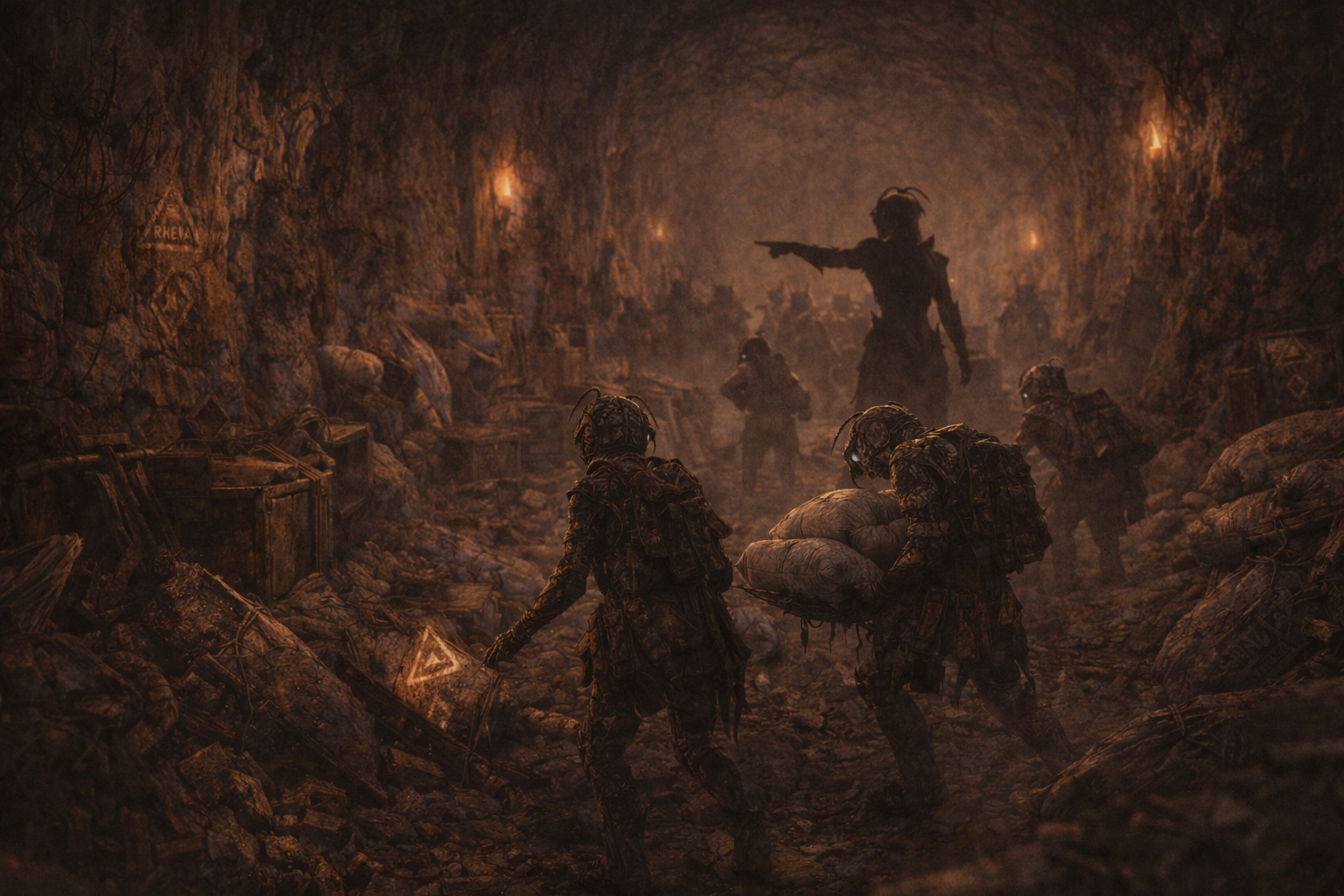
When they came out onto the lower gallery, Kharna saw that the storage room had been gutted by a gallery pierced during the night, where there had been nothing the day before. Thin silhouettes, too long for Bel-Azh workers, entered in successive blades. They bit, retreated, then came back at an angle.
Mirel emerges from a side, his chest scratched with a fresh cut.
— They open the front, then they break the return line. If we charge straight, we cut ourselves off.
Yenna arrived behind her with six dust-black guards.
— Ashra still holds the larvae gate, but pressure is also building to the south and the line is starting to bend.
Kharna planted its paws in the mud. A thought came up, brutally, the same as under the collapse of her birth. What if I read the ground wrong?
She squashed the thought before it became an internal order.
— Mirel, closing triangle on the warehouse. Yenna, you clear the traffic to the nursery. Siltis with me. No hunting. No glory. We keep them alive.
The order went out, then ran into invisible resistance. It was the fear of his people. Two young guards backed away instead of advancing. A conveyor belt dropped her bag and cowered in the middle of the passage.
Kharna jerked her upright, then forced her to catch her breath.
— You move with me, you breathe, and you join Yenna without leaving the line, now.
The conveyor obeys. Command, Kharna understood, was not always convincing. It was sometimes lending a rhythm to bodies that wanted to collapse.
The first shock was dirty. The intruders refused full contact. They bit, retreated two lengths, then came back to cut on the flanks. Each individual heroism opened a collective fault.
— Close the gap and hold the interval! shouted Siltis. Do not pursue intruders; closes the void and remains in support.
A rumble came through the ceiling. Wet earth fell in patches.
Yenna tumbled out, covered in dust and almost out of breath.
— The nurses' gallery becomes blocked; if it closes, we lose the entire line of larvae.
Kharna looked at the warehouse, the break in the ceiling, then the narrowing nursery corridor.
— We abandon half of the food. We open the larvae route. Hold back, no rush.
Mirel clenched his mandibles.
— We've already just bled for this stock, and we won't last long if we let go now.
— If the warehouse falls, then let it fall. We will not bleed for the illusion of keeping it whole, replied Kharna.
They executed under the bites. Sacks of meat remained on the ground. But the road to the nursery reopened when two nurses staggered into view, loaded.
A larva slipped and rolled. Ashra appeared, collected it and pushed it back behind the line.
— Three breaths, no more, then cut and fold neatly, ordered Ashra.
The third was too many. A young guard fell, throat open. Anger rose in Kharna, wide, hot, almost happy to find a target.
She looked at the dead woman, then at the living ones, and forced her anger to stay on the line.
— Orderly withdrawal. Mirel, you take the last ones. Yenna, no one crosses alone. Siltis, marks the closure, cuts Kharna.
They retreated step by step. Ashra caused a partition prepared as reinforcement to give way. The secondary tunnel was blocked with a dull crash.
A thick silence fell. Then the injured began to breathe again.
But the silence did not last. In the side galleries, shards of stone continued to fall and the short shocks made it seem like a return attack. Ashra deployed its triage feeders in pairs. One stabilized, the other noted the odor and the lesion on a strip of fatty clay.
— Priority thorax, breath and frank hemorrhages, said Ashra. Shell wounds wait if breathing holds.
Kharna walked through the line of wounded, memorizing the faces. The exercise made her nauseous. Each stop reminded her that the order she had just given had displaced death, not disappeared.
A conveyor tried to get back on her feet before her hind leg was bandaged.
— You're not leaving again, said Kharna. You're still shaking.
— I can hold on, protested the conveyor.
— You will hold up better to the next shock if you hold together now, cut in Siltis.
The conveyor lowered its antennas and gave way. Kharna noted the detail. Siltis had used the verb to hold, not to obey. In a colony on its last legs, this nuance was equivalent to real authority.
Mirel returned from the front with two guards, short of breath, their mandibles still stained.
— They no longer grow. They observe.
— Where, exactly, asked Kharna.
Mirel rubbed the dust from his chest with a sharp gesture.
— Blind spots. Above the break. They test our covers, not our walls.
Kharna moved Yenna forward to the emergency map drawn on a wet slab. The cartographer placed three black grains to mark the breaking points, then two light grains for the false signals heard during the withdrawal.
— They used two entries that we thought were dead, said Yenna. Not heavy attack axes. Areas of listening.
— We close both, ordered Kharna.
— If we close in raw, we also block our reserve conveyors, replied Yenna.
— So we close in teeth. Every other partition, with a breathing airlock, says Kharna.
Siltis nodded.
— It slows everything down.
— I prefer a readable slowdown to a speed that makes us blind, replied Kharna.
In the treatment room, a young guard began to laugh quietly, her eyes fixed. A shock reaction. Ashra made her lie down, placed her paws on her chest and counted the breaths in a low voice until the laughter turned into sobbing.
Kharna stayed near them without speaking. She knew that a queen who spoke too many sentences at such times transformed pain into scenery. She chooses the opposite. She took a damp cloth, cleaned one wearer's wound herself, then moved on to the next one.
— You don't have to do this, the carrier whispered.
— Yes, says Kharna. I want to know what my orders cost in the corps, not just in reports.
After half a quarter, the breaths finally synchronized. Ashra announced a first provisional assessment, without emphasis.
— Four deaths confirmed. Nine seriously injured. Thirteen lightly injured people who can still be used tomorrow if we give them full vigil.
The figure hit the gallery like another collapse. Mirel looked away towards the wall.
— We let them get too far ahead in storage.
— No, replied Kharna. They forced us to choose between two losses. We chose the one that left the larvae alive.
Yenna placed a finger on the map.
— If they return through the same opening, they can be scissored from the east elbow.
Mirel shook his head.
— If they come back that way, it's because they want us to wait for them there.
Kharna felt the fatigue enter their voices. They were all right, each in a too short radius. Her role remained to hold the long beam.
— You will each sleep a quarter before the next council. No negotiation.
Mirel protested under his breath.
— I sleep after the counterattack.
— You sleep now to have a counterattack, said Kharna.
Siltis led the way towards the resting alcoves, keeping his tone neutral.
— This is not a favor. It's a survival instruction.
Before letting them go, Kharna stopped in front of the still vibrating wall of the gutted chamber. She placed a paw on the warm stone, closed her eyes for a second and silently swore that no one who had died this day would become a lost number. If Bel-Azh were to hold, it would be with complete memory, not with effective forgetting.
The improvised relief room fills up in less than a quarter. Cut, suffocated and trembling wounded women were piled up; some only heard on one side. Kharna counted, recounted, refused to look away.
A worker asked in a broken voice. — Will my sister come back through this passage, or have we already lost her?
— I don't know yet, replied Kharna, and I won't lie to you to calm the fear.
The frankness cost him more than an order. But the worker's gaze stopped drifting.
The crisis council stood, in a gallery which was still oozing. Siltis laid out the facts, starting with losses, then remaining inventory and compromised segments. Mirel detailed the angles of attack. Yenna pointed out the areas where panic had transformed the conveyors into obstacles. Ashra spoke last.
— They will come back, says Ashra. Not to finish the job today, but to test our reflexes until we find the flaw.
Kharna made three marks in the wall.
— First rule, no pursuit without a way of return validated by two leaders. — Second rule, the larvae go before the food as soon as the air changes. — Third rule, any section can block an order if it detects a false signal, but in clear voice and smell of counter-order.
Mirel raised his head.
— Do you really give us the right to contradict an order under pressure?
— Yes, and I will keep it even if it costs me to lose the last word.
The second attack arrived before the night shift. Bel-Azh did not rush. The counter-order bearers went first. Mirel closed the corner. Yenna emptied the laterals. Ashra opened a false passage marked as a weakness.
The intruders took the bait. The ceiling broke under three of them. The others tried to pick up at an angle.
The fight was short, brutal, inglorious.
When the dust settled, Bel-Azh had two more dead and seven enemy bodies. Nobody celebrated.
— They also learn, says Yenna.
— Then we will be cruel with our habits, replied Kharna.
No one left the area right away. The dead remained on the ground while the scouts triple-checked the ceilings. An injured intruder again tried to crawl towards the north gallery. Mirel finished him off with a clean blow, then retreated without triumph.
The cleaning lasted until the end of the day. The enemy bodies were taken out one by one, weighed, examined, and then moved to a separate chamber for study. Ashra imposed resin gloves on the handling teams.
— No direct contact with their mandibles, she said. I want to know if they carry marking powder.
Yenna supervised the track survey. She traced the entry steps, the pivots, the braking zones with charcoal. After an hour, the pattern appeared.
— They are not looking to occupy, she said. They seek to make us overreact in ways where we block ourselves.
Kharna let this sentence settle in the group before responding.
— So we take away from the enemy the right to choose our speed.
Siltis opened his sleep register.
— That means shorter instructions and clearer prohibitions.
— Above all, it means that we stop confusing courage and haste, replied Kharna.
A young guard, still covered in dust, dared to raise her voice.
— If we still wait for confirmation, we will also lose sisters.
Kharna approached her.
— You're right. So we won't wait forever. We will decide when to accelerate and when to lock. This choice will no longer be left to panic.
The guard tilted her head, troubled but attentive. Kharna saw in this look what she feared the most. The need for a rule that holds when fear returns.
The naming ritual was brought forward to the same evening. Not the next day, not after rest. Right away. The sections lined up in the casualty gallery. One by one, the dead were named with their function, their axis and the decision which had exposed them.
When the name of the youngest guard who fell near the nursery came, Mirel's voice broke despite herself.
— Halin, second line guard, died while maintaining larvae corridor.
A heavy silence followed. Kharna did not erase this silence.
— We won't replace Halin with a heroic phrase, she said finally. We will replace Halin with a better rule and a better run team.
After the ritual, Siltis summoned the axis leaders for an immediate field audit. They repeated the journeys with empty loads, timed the bottlenecks, noted the points where a body on the ground blocked the entire line.
The report was brutal. Three main corridors still depended on a single passable passage. Two tipping points did not have a distinct fallback signal. And the support sections arrived too late as soon as the front shifted by more than an elbow.
— We live on an architecture which supposes the good faith of the field, says Yenna.
— The land has never had good faith, replied Mirel.
Kharna decided without raising her voice.
— Tonight, we are not rebuilding everything. We close what kills us quickly and we accept losing performance.
Siltis took note.
— Priorities.
— One, double the roads to the nursery, even if it's narrow. Two, install bypass niches every twenty steps on the charging corridors. Three, impose a single stop signal, audible and olfactory, that no one discusses during the assault.
The work began before dawn. The workers grumbled when they learned that it was necessary to break off portions that were still new to install removal niches.
— We're destroying what we dug yesterday, one of them said.
— We destroy what encloses us, corrected Kharna. Digging is not sacred. Surviving is.
Amidst the mandible hammers, Ashra returned with a discovery.
— Two dead intruders had a dry fiber under their shells impregnated with a returning odor. They could mark our walls while fleeing.
Yenna understood before the others.
— They don't need to win every raid. They need to map our responses.
Kharna looked at the blackened map, then at the exhausted faces around her.
— So every time they come, they will receive a different answer.
This choice had immediate costs. Sections had to learn variations instead of a single reflex. Some got the sequence wrong. Two internal collisions took place when changing lanes. No deaths, but avoidable injuries.
Mirel gritted his mandibles.
— We are hurting ourselves with our corrections.
— Yes, says Kharna. The difference is that we can correct our mistakes. Theirs, no.
The end of the watch did not bring any new attack. Only background noise, distant knocks, intermittent smells. The kingdom remained standing, but it was no longer stable. This instability became their work material.
The next four days were worse in duration than in intensity. Brief bites, false signals, micro-collapses far enough to divert sections. Fatigue became the most stable enemy.
Kharna imposed forced rest cycles.
— You sleep now, even if you hate order, or you will kill your sisters out of fatigue before the enemy.
The protests were immediate.
— Rest does not fill the bags, launched a conveyor, and hunger will not wait for us.
— No, says Kharna, but without rest we won't survive long enough to fulfill anything.
To make the order acceptable, Kharna stopped treating it as morality. She transformed it into a visible procedure. At each shift, a fatigue table was engraved in the clay with three marks.
The first indicated the sections suitable for impact. The second, the sections suitable for transport. The third, those who had to remain in strict support.
At first, no one really respected the third mark. Volunteers sneaked in to go back to the front pretending to go get bandages.
Siltis had two controls placed on each output.
— Section name, charge, destination, she told everyone who tried to pass. If any of these three things are missing, you go back to sleep.
A guard protested, clenching her paws.
— I sleep and my sister dies somewhere else.
— You don't sleep to abandon him, replied Siltis. You sleep so you don't become the next one to save.
Kharna added a guardrail which was more shocking. Combat leaders also had to leave the line on mandatory rotation, even at the height of tension.
Mirel flatly refused.
— I'm not going to bed while it's biting.
— You're not going to bed. You go to reading position for a quarter, says Kharna. You remain useful without wearing your reflexes beyond recovery.
— It's a luxury.
— It’s an economy of deaths.
The first test went badly. Mirel, moved to read, corrected too late a false signal on the south axis. A conveyor took an unnecessary detour and lost a load. Mirel wanted to immediately return to the front to compensate.
Kharna stopped her.
— You do not erase an error by punishing yourself.
This sentence circulated in Bel-Azh faster than a withdrawal order. Some accepted it as a new discipline. Others considered it a dangerous sweetness.
To decide, Kharna had the figures from the last three days compared. On the sections where the forced rest had held, losses fell. On sections that remained in continuous flow, serious bites climbed and reading errors doubled.
She displayed the numbers in the center, without comment.
The protest diminished, but did not disappear.
Yenna then proposed an intermediate method for pressure days. Each section had to designate a lucidity pair. One executed, the other checked. Then they reversed in the next shift.
— If one slips into the tunnel of fatigue, the other brings her back, Yenna explained.
Ashra completed the method with simple physiological signs.
— If the antenna shakes continuously, you switch to support. If you miss two counts in a row, you leave the line. If your breathing breaks at the top of the thorax, you are no longer carrying a load.
The elders gnashed their mandibles at what they called school medicine. Then they saw that these rules prevented clean breaks. The objections changed their tone.
One night, Kharna surprised two guards exchanging signs of fatigue to stay together at the front.
— Two people are better, says one.
— I believe so, replied Kharna. But if you cheat the mark today, you will also cheat the signal tomorrow. And there, you will bring down your entire line.
She doesn't punish them. She assigned them to the training of novices for two watches.
— You know what it's like to hold together. Learn it without lying about your limitations.
This type of sanction caught on. Instead of humiliating, he redistributed competence. Bel-Azh began to transform his mistakes into methods, slowly, at the cost of a patience that no one wanted to pay but that everyone eventually understood.
Meanwhile, the enemy front remained unstable. No big assault. Only regular touches, enough to prevent full recovery. The night sections all described the same impression.
The enemy was not looking for a wall. She was looking for a moment when Bel-Azh would forget her own rule.
Siltis posed this sentence to the council.
— They watch for our negligence, not our weakness.
Kharna validated a new short-range instruction.
— Each critical order is repeated by a different voice before execution. Not to extend it. To force listening.
The reaction time increased by a breath. This blast saved three internal collisions in two days.
On the fourth evening, a conveyor belt collapsed on the ground and blew between two spasms.
— I don't like this new kingdom. We think more than we breathe.
Kharna sat down next to her.
— Me neither. But I like the one where we bury in series even less.
The conveyor closed her eyes, then nodded.
— So make sure we don't forget why we care.
This request weighed on Kharna more than an accusation. She understood that forced rest, rotation and double confirmations would not be enough. It was necessary to maintain a legible horizon for exhausted bodies.
She therefore had three non-negotiable priorities engraved at the entrance to each active axis.
Alive. Water. Larvae.
Everything else became variable.
When the secondary water bag came back on the table, no one treated it like a prestige mission. It was a raw need, under duress.
On the fifth day, the secondary water bag returned to the table. Its access went through a narrow gorge, easy to trap. Siltis wanted to give up. Mirel wanted to resume immediately.
Kharna weighed the two wounds.
— We go there, but we go there like organized thieves, not like conquerors who want a trophy.
The exit section was reduced to twelve members. It had four guards, four conveyors, two scouts, Teren in closing relay and Kharna in the lead. Siltis remained in the center to maintain the continuity of the kingdom.
The journey was slow, almost funereal. The micro-beacons of Yenna, hidden under the rock lips, avoided the exposed walls. The throat smelled of rotten moss and hot stone. Twice the line stopped with a sharp noise from above.
At the pouch, Ashra dipped the tip of his mandible in the water, let it roll over his tongue, then raised his head.
— It is filterable, she says. But not here. The raw water is brought up and purified in the center, under control.
Teren, at the back of the line, placed an antenna against the wall.
— Contact incoming, she whispered. High axis. Irregular speed.
The air current turned before the assault. A second later, figures slid from the ceiling in dislocated clusters.
— No ascension, ordered Kharna. We protect the charges. Block withdrawal.
The first wave targeted the bags, not the guards. A leather bag burst under the mandibles. The water splashed down the slope and turned the ground into living mud. A conveyor belt was thrown to hold the opening. Teren hit her with his shoulder and pushed her back behind the row just as a bite slammed into the void.
Withdrawal became a brutal mechanism. Two steps, cover, passing a bag, recovery. Mirel held the head of the column, Kharna closed the corners, Ashra counted the charges in a low voice so as not to lose anything in the tumult.
Hal, the front guard, slipped on the silt and was bitten in the chest. She stood straight for two steps, struck again, then collapsed against the wall.
— We wear it! We're not leaving her behind! a conveyor belt shouted as she broke the line.
— No station, decided Mirel. We cover it on the move or we lose the whole group.
Hal shook his head, his mouth red.
— Not me, she whispered. Keep the bags. Stay in line.
Hal didn't move. The line hesitated for a second, then resumed its march. In Bel-Azh, no one had the luxury of stopping.
Kharna knelt down, placed a paw on the back of Hal's neck, then stood up in one motion.
— Complete withdrawal. NOW. Cadence intact.
When they came out of the gorge, three bags out of eight remained. Two seriously injured people were still standing. A guard was missing.
In the center, the exit report tore the sections. Some accused the queen of having risked twelve lives for impure water. Others replied that this water would run out in two cycles.
Kharna did not plead. She announced the losses, had the water purified, and ordered that Hal's name be engraved before distribution.
That same evening, Teren asked to speak.
— The counter-order doesn't come fast enough in a gorge. The carrier must be able to stop the line with one breath if the withdrawal becomes fatal.
Silence fell, because the idea was dangerous, and that was precisely why it became useful.
Kharna validated.
The rule took a name. The blast of charge.
She saved three sections in two days.
The first time was in a transit corridor where no one expected an incident. A line of conveyors was coming up from the low level with bags of wet salt when a lateral settlement cut the wall at an angle. The passage remained open, but the ground vibrated like stretched skin.
The old doctrine would have ordered acceleration. Teren, who was closing the line, instead gave the brief signal of the charge blast.
The entire section stopped in one movement.
A second later, the lip of rock in front of the first conveyor gave way silently. If the line had continued, the first three would have fallen into a gap of dead water.
The rumor of this rescue circulated quickly, then turned into a caricature.
Some leaders claimed that everything could be suspended on the slightest doubt. Kharna cut the second tip short.
— The charge blast is not a license to panic. It is a right to stop when a withdrawal kills more than it saves.
It imposed three criteria for use.
Immediate risk of rupture. Non-sacrificable charge. No clear relay within twenty steps.
If one of the three was missing, we moved forward.
Mirel validated the doctrine, but demanded a quid pro quo.
— If we give this right, we also sanction abuse.
— Yes, replied Kharna. Not out of humiliation. By retraining.
The reward arrived faster than expected. A western section used the charge blast on a simple doubt of smell. Result. Traffic jam, two collision injuries, a lost bag.
The offending leader, Eln, introduced herself.
— I was afraid of the false signal.
— You confused fear with proof, Teren replied.
Kharna assigned Eln to five days of simulated gorge exercise with public reporting.
— You will relearn how to name what you know and what you fear.
Eln accepted without question. By the end of the third watch, his reports became precise enough to serve as support for other sections.
Siltis saw a cultural gain greater than the rule itself.
— We are in the process of normalizing the admission of error.
— Not the confession, corrected Kharna. The correction.
Between these learnings, the war continued to bite bit by bit. A false collapse diverted an entire patrol towards an unimportant axis while three intruders tested the reaction of the northern post. They did not seek to kill. They sought to measure the counter-order delay.
Yenna produced a table of deadlines that froze the council. The excellent sections responded in six breaths. The exhausted sections numbered twelve.
— At twelve, says Yenna, we are no longer in tactics. We're in the lottery.
Kharna ordered an unpopular measure. Sections above ten breaths automatically switched to short mission until returning below threshold.
Mirel feared an overall drop in pressure.
— We're going to leave holes.
— We are blocking invisible holes that are already killing us, replied Kharna.
To compensate, it temporarily merged two experienced units into a mobile emergency cell. This cell only had one mandate.
Repair lost seconds.
They crossed the active axes without anchoring, brought relays, reading, extraction, then left. At first, the local leaders took it badly.
— We don't need a war nanny, said one of them.
The same leader requested the cell two days later when her axis took a double false signal.
In the same period, Ashra reported another slip. The lightly injured relapsed because they resumed loads too quickly so as not to appear weak.
Kharna convened the sections concerned.
— We should not confuse dignity with self-sabotage, she says. A stabilized injured person remains a resource. A relapsed injury becomes a loss.
She had the service marks changed. A worker in recovery now wore a light shade recognized everywhere. Impossible to force her to a heavy load without a signed order.
The measure triggered mockery among certain guards.
— They're painted as fragile, Mirel growled in private.
— No, replied Kharna. We protect them from our collective impatience.
Mirel didn't approve right away. However, she saw the result the following day. A clear-marked carrier was kicked off a heavy axle before a relapse broke it. The reflex began to take hold.
This progress remained costly. Each rule gained took time. Every minute taken at speed seemed offered to the enemy. But Bel-Azh began to move away from a logic of reactive survival and enter into a logic of transmissible survival.
Kharna understood that this transition was precisely what the enemy was trying to prevent.
Then she accelerated again.
The fatigue had barely subsided when another anomaly appeared. Then fraud entered the war, with almost administrative precision.
A maintenance worker showed up at the north station with the right smell, the right bag, the right pace. Teren let her pass two lengths, then called her back.
— Give your backup name and the team that passed you on, Teren said.
The worker answered without hesitation.
Teren didn't move.
— Sema died yesterday, and no one uses her name today.
The worker tried to flee. She was tackled before the elbow. Under the blanket smell, a foreign trail appeared, thin as a thread.
Kharna understood that the war was changing scale. Danger would no longer always have raised mandibles. Sometimes she would wear a perfect routine.
She broke the cycles. It imposed reverse rotations, absurd hours, swapped teams. A day of logistical chaos followed. Then Bel-Azh became hard to read again.
This gain was paid dearly, and no one in Bel-Azh had any illusions about the price.
Dera, sentry of the east wing, died at the change of shift. Not from a bite, but from exhaustion and a slow hemorrhage not seen in the night.
Kharna stayed close to her.
— Tell me the truth, is all this still useful? Dera asked.
— Yes, and I hold it in my bones, replied Kharna.
— So remember my name too, so that it doesn't disappear with this quarter.
Kharna engraved the name herself.
The fine surface rain the following night changed the acoustics of the galleries. Yenna proposed long listening posts. She didn't want interpretation, only rhythms.
The second station reported a repeated cadence, never at the same axis, always at the same interval.
— It is not an ordinary front, says Siltis, it is a signature which seeks to condition us.
On the same watch, a young enemy scout was captured by accident. She slipped on a strip of fresh clay and her hind leg got stuck in a groove. She tried to smash her head against the wall. Ashra blocked it.
They took him to the witness corridor.
The prisoner did not say a word.
Yenna placed in front of her a fragment of food marked with a foreign odor. There was a micro-movement. Almost nothing.
— It does not protect a place, says Yenna. She protects a track.
Kharna asked a single question.
— Who reads our feedback and corrects your movements?
The prisoner breathed, very low.
— The one who never forgets, she finally whispered.
Then she bit her tongue at the blood and walled herself into silence.
Mirel wanted immediate execution. Siltis wanted to release it marked to follow a return. Kharna decided between the two.
— We keep it for a cycle. Then, we choose the form of the next contact.
At the change of watch, Teren placed a marked grain in the palm of Kharna.
— I found it on a clean track, too clean to be honest.
Kharna looked at the sign without touching it.
— We go to the center, straight away, and no one leaves the line.
Teren took the lead in the line. Two guards closed around Kharna so that no one would accidentally brush against the fragment. The main gallery seemed empty, but the emptiness was no longer reassuring. At each crossing, a sentry announced her name, her route and her relay scent before letting the group pass.
The journey to the center took less than a quarter and seemed endless.
Halfway, a carrier emerges from the side with a message to fall back.
— Order of Mirel. We empty the southern reserve immediately.
Siltis blocked it with a gesture.
— Mirel has been in the east for two watches. Who sent this to you?
The carrier hesitated for one breath too long.
— A black chef with a gash here, she said, touching her chest.
Kharna felt the cold enter behind the mandibles.
— Continue to the southern reserve and wait for my signed counter-order. You don't move anything without validation.
The carrier left, shaken. Maybe it was just a mistake. Maybe it wasn't just a mistake anymore.
In the center, Kharna had the reading panel isolated. No one entered without a double witness. Yenna, Ashra, Siltis, Mirel and Teren took their place in a small circle. The others stayed behind the salt line, at a distance.
Mirel arrived last, still marked with dust.
— I had two axes locked, she said. We also intercepted three conflicting messages about nighttime charges.
Mirel raised his head.
— Contradictory how.
— Same instructions, three different times.
Yenna tightened the antennae.
— They don't just cover our tracks. They confuse our calendar.
Kharna opened the session straightforwardly.
— We have a prisoner who talks about a boss who never forgets. We have intruders who seem to know our reaction times. And now we have this grain placed on a clean track. I want useful hypotheses, not stories that reassure us.
Ashra asked to inspect the fragment first. She lightly moistened a strip of stone and approached the grain without direct contact.
— No quick poison. No resin known to us.
Yenna took over and swirled a salt torch around the sign.
— Recent engraving. Strong pressure, fine tool. Those who did this knew we would see it right away.
— So it's an invitation, grunted Mirel.
— Or a beacon, replied Siltis. A way to check if we are still following our protocols when we are tired.
The circle fell silent. Each evaluated the same thing. If the enemy already knew their internal rhythm, then Bel-Azh was pierced deeper than its galleries.
Kharna had the prisoner captured earlier the day brought in. She entered framed, her hind leg bandaged, her gaze fixed.
— You said. She who never forgets, launched Kharna. This sign belongs to her.
The prisoner did not respond.
Ashra placed two fragments in front of her, one neutral, the other marked.
— Show which one you recognize.
The prisoner looked away. Then, almost in spite of herself, her antennae quivered towards the marked fragment.
Yenna observed the movement.
— She knows her.
Mirel took a step.
— Give us a name and hold your tongue.
The prisoner laughs without sound.
— A name wouldn't do you any good if you don't understand the method.
Kharna moved forward to eye level.
— So give the method.
The prisoner closed her eyes for a few seconds. — You think you are protecting places. We read your feedback, she whispered.
— With what.
— With what you leave when you're afraid of wasting time.
Mirel wanted to resume the interrogation by force. Kharna raised a paw to stop her.
— Go on.
The prisoner shook her head.
— I've already talked too much.
She squeezed her mandibles until they bled. Ashra stopped her from hurting herself further, but no more words came out.
When she was taken back to solitary confinement, the center remained silent for a long time.
Yenna ends up making the diagnosis that no one wanted to hear.
— They don't win because they are stronger. They win because we leave behind us legible decision models.
Siltis pressed.
— The reports are too homogeneous. Schedules too regular. The same leaders at the same points on the same nights.
Mirel replied immediately.
— Regularity is also what keeps us going.
— Yes, says Kharna. So we are not killing regularity. We make it opaque from the outside.
The plan that followed was rougher than expected. Kharna imposed reverse rotations on three critical axes, changed the relief pairs in full standby, and prohibited any transmission of critical orders without a cross-scent signature between two leaders.
Protests mounted.
— We are going to get lost in our own system, said a logistics manager.
— We already get lost when we remain predictable, replied Kharna.
Yenna completed with a test device. Decoy orders were injected on two non-critical corridors to measure the speed of error diffusion.
Result. One of the lures returned modified to the center in less than thirty breaths.
Siltis turned pale.
— The noise spreads faster than the facts.
Kharna transformed the sentence into an order.
— From now on, any counter-order must contain three fixed elements. Cause. Duration. Responsible.
Mirel nodded, tense.
— And we cut tactical discussions in an open corridor.
— Yes, says Kharna. More strategy in the passing galleries.
The night was advancing. The sections rotated without full rest. Errors were decreasing, but fatigue was rising like a low fever. In the midst of this tension, Ashra requested a medical check-up.
— We are still holding two watches at this level. Afterwards, I no longer guarantee the lucidity of the guards.
Kharna noted this without commenting. She already knew what that number implied.
A choice had to be made before dawn.
Mirel pushed for a preemptive raid.
— We strike now while they think they've confused us.
Yenna argued the opposite.
— If we go out under jamming, we offer our complete schematics on a platter.
Siltis remained pragmatic.
— Without knowing what this grain marks, going out is a blind gamble.
Kharna cut off the debate in a lower voice than the others.
— We're not going out tonight. We close, we observe, we produce reliable data. Tomorrow, we choose with less ego and more proof.
Mirel stared at the slab, then gave way.
— All right. A watch.
Kharna then installed a transmission chain without direct contact to move the fragment towards the central cold table. A guard took over every ten steps. Name announced, smell validated, delivery visible.
This protocol seemed excessive. He was exactly what was needed in a war where a breath of doubt could open an entire gallery.
When the channel was ready, Kharna looked at Siltis.
— Here we go.
Siltis tilted its antennae.
— Here we go.
The first guard received the fragment. The second already stretched out her paw.