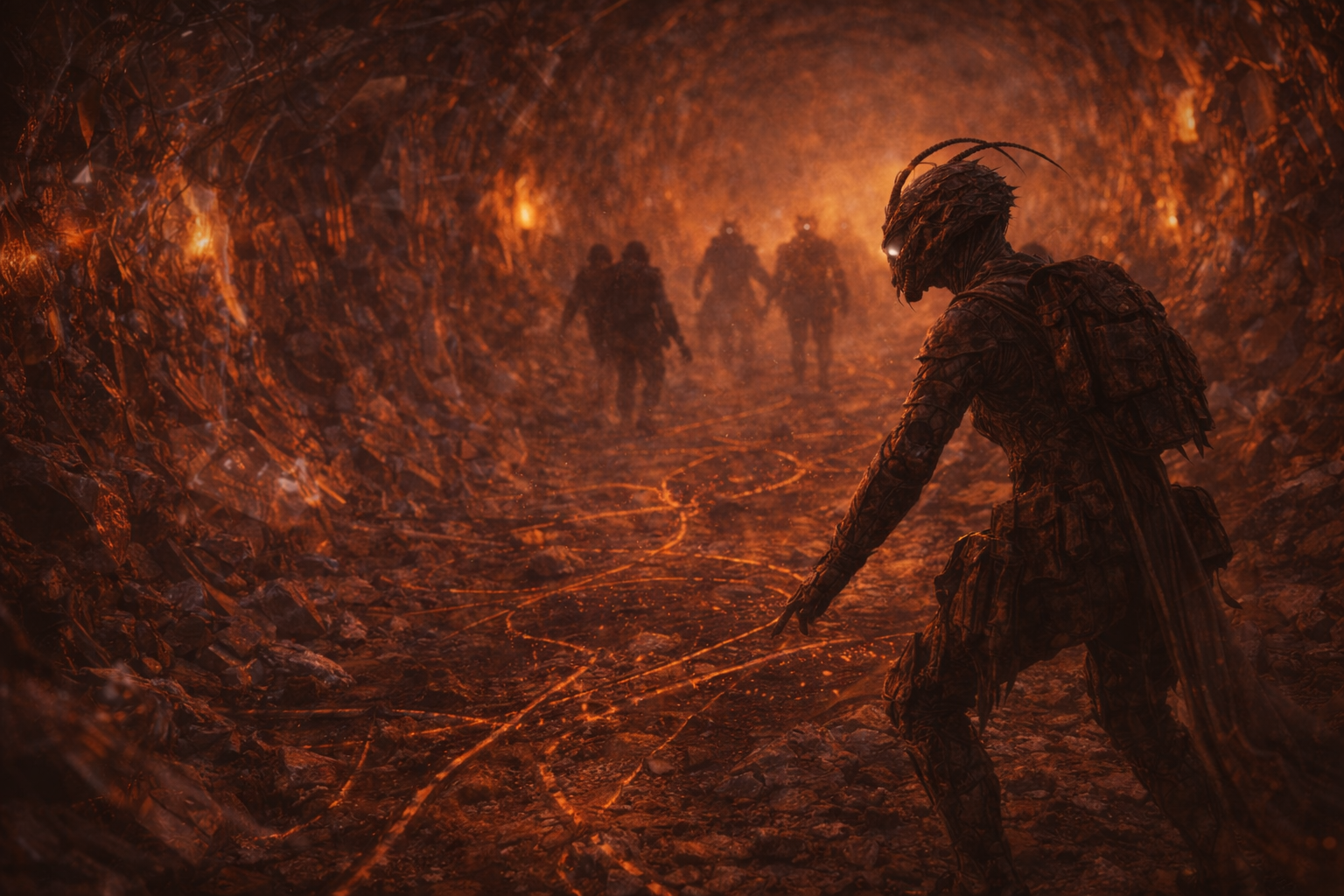
The marked grain passed from leg to leg to the center, then the gallery emptied in a single movement. Kharna placed the fragment on a damp stone. The sign remained motionless. Three lines surrounded an open circle, like a warning before the blow. No worker from Bel-Azh had left these traces. The clay around the fragment appeared intact. However, within a radius of about ten steps, the smell of the reserves was already duplicated. One track said “return”. The other said “move forward”. Both came from the same point. No worker from Bel-Azh would have left two truths in the same place. Something in the stone had learned to lie.
— They've been looking at us longer than we've been looking at them, says Siltis.
Mirel showed the entrance to the gutted reserves.
— So we force them to look fake.
Yenna knelt near the stone, antennae very low, as if the dust could lie less close to the ground.
— It's not just a brand. The support is smooth underneath. We installed it quickly, then we rubbed the wall with a dry powder. This cuts off the reading of the traces.
Kharna felt the anger rise, then recede. Anger cost time, time cost lives. She breathed once and pulled the clay card towards her.
— We close everything that leads to the reserves except one axis. Mirel, you lock. Yenna, you find me the source of this powder. Siltis, no rumor. I want facts, injuries, hours, not myths.
The immediate goal was simple. Cut off the interference around reserves and identify its source.
Closing took less than a day. Lines collided. Bags were sewn up on the move. Two porters swore that they had seen a silhouette of Siltis ordering them to take a detour into a gallery where Siltis had never set foot. The Glass did not attack head-on. It first opened a gap in doubt.
The first test lane was prepared like an autopsy. Three sentinels at the start, three in the middle, three at the exit. Each group carried a distinct odor, etched on the thorax in salty resin. At the slightest deviation, we returned to point zero. It was first necessary to check what information still held. Kharna took the lead, not for show, but because she refused to delegate ignorance. Under his claws, the wall was smooth and unusually warm. The contact made rubbing almost beautiful. Too beautiful. A second after each step, the ground sent back a phantom vibration. The stone responded too late to be an echo. The stone retained the memory of the movement. Or maybe she was learning it.
— It responds late, whispered Yenna. It’s this delay that kills.
A novice raised her head too early, thought she recognized a return beacon, turned, and placed a paw in the void of a lateral drop. Mirel caught her in the chest before the fall.
— You look at the rock like a face. Look at her like a trap, said Mirel.
We took another twelve steps forward. Then Kharna stopped everything.
If Glass could imitate tracks, he could imitate the voice.
Perhaps his voice was no longer proof.
The patrol returned before the heat subsided.
Bel-Azh listened to the report quietly.
Impossible tracks. The vibrations coming back from the ground. The voice that could be imitated.
Kharna did not speak immediately.
She let the colony sense the danger.
The rule was engraved that same evening.
In the Glass zone, the voice of a commander no longer commands alone.
All orders must bear two confirmations.
The following night, the enemy confirmed the protocol. A supply team received a false order to withdraw. The relay smelled exactly like Ashra, except for a metallic note that no one noticed. Without the double confirmation, the line would have opened the north lane. With the rule, they stopped in time. One injured, no loss of brood.
Kharna spent the end of the watch sorting reports. She crossed out, counted again, crossed again. Each time a witness said “I thought I saw”, she demanded “I touched what, smelled what, heard who”. At dawn, a pattern appeared. False leads appeared especially near glazed surfaces, where air circulated poorly and odors stagnated. Someone knew their intimate geography.
— They don't test our walls, Kharna told the council. They test our reflexes.
Siltis nodded, but his gaze remained fixed on the loss column.
— If we only play defense, we also teach them our tempo.
— So we go on the cognitive offensive, says Yenna.
Mirel raised an antenna.
— In plain language?
— We give them false certainties. We create visible habits and invisible decisions.
The installation required work that no one would see. The plan was to lure the enemy reading into the wrong place. Tags were intentionally moved half a finger to create routine patterns. “Bait” convoys circulated on unimportant routes, with deliberately exaggerated noise. At the same time, the real reserves were divided into mobile pockets, moved at irregular times. Bel-Azh agreed to be predictable in order to become unreadable again.
Mirel led the first bait convoy with poorly concealed annoyance.
— I hate playing the fool in front of shadows.
— You're not playing dumb, replied Siltis. You play the one who understands theater.
A few days later, the attack arrived exactly where Yenna predicted. On a noisy axis, rich in traces, poor in reality. Three raiders from Khir-Nammu came across an empty warehouse, trapped in greasy sand. The controlled collapse cut them in two. One was captured alive, one died of asphyxiation, the third escaped leaving a clear trail towards a dry gallery.
Kharna wanted to continue. Mirel too. Siltis says no.
— It's too clean. They want us to run.
The decision was to hold and then question the prisoner. The goal was to understand the protocol, not to vent anger. It was a long process of silence. No theatrical torture. No unnecessary threats. Ashra observed the micro-responses, the odor variations, the mandibular contractions. Yenna rephrased, Kharna listened.
We learned little, but it was already a lot. The word "Glass" was not a place name, it was a jamming protocol passed between colonies. And this protocol had been “improved” recently. By whom, the prisoner ignored it or pretended to ignore it. One name kept coming back, though, never fully pronounced. Rhe… then a clear blockage.
— Even their fears are hierarchical, Kharna whispered.
The next day, an incident almost ruined the entire effort. A new mixed team entered the Glass zone with the wrong confirmation sequence. The leaders both spoke at the same time. A carrier interpreted “keep the axis” as “keep the load”. She remained forward while a withdrawal was requested. The wall slid. The shock crushed his pelvis. She survived. Half.
The board room hardened around this error. Mirel demanded immediate sanctions.
— If we forgive that, we sign other bodies.
Yenna remained cold.
— Punishing does not teach the syntax of an order.
Kharna decided otherwise. The two heads responsible were neither promoted nor dismissed. They were assigned fifteen days of training for novices, in forced pairs, in front of witnesses. Each ambiguity had to be noted, replayed, corrected.
— You have created an injury through confusion. You will repair the confusion before those who inherit your orders.
This decision divided, but inspired. In less than three days, messages in the Glass zone lost a third of their length. Less noise, less prestige, more survival.
Bel-Azh did not win peace; it gained clarity.
In the midst of this relative calm, Kharna allowed herself a detour towards the larvae chamber. The contrast took her breath away. Outside, there was the strategy. Inside, the raw heat, the tiny tremors of births and the white smell of the brood. She stood for a long time watching a nurse repair a cocoon crack with infinite precision. The war seemed obscene, seen from here.
Siltis joined her without making any noise.
— Do you doubt?
— I calculate, says Kharna. And sometimes I hate what it requires.
— That's a good sign.
— No. This is just the price of ordering.
Siltis gave a brief amused breath.
— So let's call it lucid.
The next phase was more ambitious. Turn the Glass against its designers. Yenna proposed a “deaf” room, without a stable olfactory beacon, where only contact sequences would allow passage. We had to learn to decide without depending on the smell. Mirel saw it as operational madness.
— You want us to blind our own teams.
— Temporarily, says Yenna. To learn to read differently.
Kharna validated on the condition of a safeguard. No novices in the anechoic room, no critical load, no nights away. We tested with experienced pairs. The first minutes were chaotic. Bodies collided. Orders died halfway. A brutal rage rose among the best. Then a rhythm emerged. Left paw on shoulder, pause, mandible contact, resume. A non-verbal language, slow but unfalsifiable.
The discovery had the effect of a blade. Glass knew how to lie by smell, less by touch.
Kharna then ordered hybrid training. Three usual channels in standard zone; in saturated zone, contact priority; in red alert, olfactory silence and gesture relay. The colony became less intuitive, harder. Some elders complained about it.
— Our way of doing things is being stolen from us.
— No, replied Siltis. His innocence is taken away.
On the eighth day of this regime, the enemy struck differently. No frontal raid. No false orders. A simple contamination of secondary water points with a hydrophobic powder. The surface shone as if it were full. To the touch, it slipped dry. The smell remained fresh, but the temperature did not keep up. Liquid was leaking into dead cracks. Teams lost an entire cycle transporting wet air.
This time, Ashra was decisive. She made the oldest nurses taste the water.
— It smells clean. Too clean.
In less than an hour, the suspicious points were isolated. We switched to dry rations for a full watch. Anger spread to the conveyor lines.
— We're hungry, we're thirsty, and we're playing puzzles, a conveyor belt growled.
Kharna went down to the complaints level, without an escort.
— Yes. And I prefer your insults today to your names engraved tomorrow.
It wasn't a speech. It was a contract.
The following night, the countermeasure was launched. The real water points received a thermal signature with hot salt, impossible to reproduce quickly without giving away. A team from Khir-Nammu attempted to imitate the system and burned their antennae. Mirel pushed them back to the northern bend in a short, brutal, almost silent fight.
After the action, Mirel remained alone against the wall, chest stained with black dust. Kharna approached.
— You want to blame me for something, said Mirel.
— No. I want to thank you for sticking with it even when you don’t like the plan.
Mirel raised a mandible.
— I don't like your plans. But I like to bury my teams even less.
This was their way of understanding each other.
The days passed, and another problem arose. Cognitive fatigue. Glass didn’t just exhaust the legs. He consumed the attention. End-of-sleep errors were increasing. Yenna proposed shorter cycles. Siltis refused at first, due to lack of staff. Then a double relief error proved that holding on longer was more expensive than giving up a little yield.
The calendar was changed. Split watches, obligatory micro-breaks, rotation of roles in the interference zone. For the first time, Bel-Azh carved a rule of rest not as a favor, but as a defense.
In this forced breathing, Kharna received a strange note. Three incidents reporting a “voice from Kharna” giving contradictory orders in places where Kharna was not. Not a perfect imitation. A sufficient approximation to sow hesitation.
— They now imitate us through sound, says Ashra.
— They listen to us enough to copy our inflections, corrected Yenna.
Kharna made the most symbolically costly decision. She temporarily gave up giving direct orders to the front line. Her instructions would pass through two named relays, with the countersignature of Siltis.
Mirel protested.
— You fade away at the worst moment.
— I'm removing a weapon they're using against us, says Kharna. This is not an erasure. It's a pivot.
The result was paradoxical. The sonic attacks lost their effectiveness, but the colony had to learn to function without depending on a central tone. The chain of command gained in density. Kharna lost immediacy. She actually gained. A kingdom does not stand on one vote.
Later, the anechoic chamber delivered its unexpected reward. A maintenance team found there, under a plate of matte glass, an old circulation conduit connecting two supposedly independent sectors. The discovery explained infiltrations that had been impossible for weeks.
Yenna drew a rough map. Mirel grimaced.
— If we open it, we expose ourselves.
— If we leave it, they use it, replied Kharna.
A partial opening was decided, with progressive traps and pressure sensors. The choice was to force a legible contact without losing the axis. The first hours were calm. Then a sharp signal. Three impacts. A limited collapse cut the conduit into pockets. Two enemy bodies and a clay tablet covered with short notations were recovered.
Ashra slowly deciphered.
— These are times of passage. Not battle plans.
— They measure our rhythms, says Siltis.
— They don't just want to come in. They want to know when we are weakest, concludes Kharna.
The war changed its nature at that moment. It was no longer a duel of strength, but a predation of pace.
The night council was the harshest since the foundation. Mirel called for a total closure of the Glass zones.
— Let's go back two rooms. We are concrete. We wait for them to break their mandibles.
Yenna shook his head.
— If we step back without learning, we offer the ground and the memory. They will come back with better things.
Siltis looked at Kharna.
— You have to choose how much pain you can still absorb.
Kharna remained silent for a long time. Then she spoke, lowly.
— You can't hold on by closing your eyes. We hold on by agreeing to learn faster than they adapt their traps.
The line chosen was mixed. Tactical removal of two exposed pockets, maintenance of learning axes, reinforcement of brooding chambers. No heroic option. A compromise of survival.
The following days proved that the compromise could work, provided it was extremely rigorous. Teams began reporting their own biases. “I think I feel”, “I think I hear”, “I haven’t confirmed”. This technical humility saved more lives than the brilliant charges.
One evening, a novice asked Kharna why she demanded that doubt be mentioned in front of everyone.
— Because a hidden doubt becomes a dirty order, replied Kharna.
The novice nodded without responding. Later, she saved her partner by refusing a “too obvious” lead. Kharna saw the report passing by and recognized her own fear transformed into a method.
Later, an unexpected event suspended the movement. A secondary tunnel, sealed since the first attacks, reopened from the inside with its own precision. No explosion, no collapse. A clean cut. At the entrance, no body. Just a flat stone, marked with three lines and an open circle, as on the first day, but accompanied by a sentence engraved in an ancient guard syntax. “You correct it quickly. »
Mirel wanted to break the stone.
Yenna stopped him.
— No. It's a measure. If we break it, we lose data.
Kharna left the stone in place, under guard.
— They no longer look down on us. They evaluate us.
— It's not better, says Siltis.
— No. It's more dangerous.
At the same time, Ashra reported a disturbing phenomenon. Some internal tags returned an olfactory note that belonged to Bel-Azh, but with an impossible delay. As if the colony was copying itself.
— Glass no longer only imitates the enemy, says Ashra. It also imitates our habits.
Kharna then understood what was happening. The jamming had crossed a threshold. It no longer opposed an “us” and a “them”. She transformed the kingdom into a labyrinth of competing versions.
The final shot of the sequence was launched before dawn. Purging old tags. Full rotation of voice codes. Redistribution of key roles. And above all, voluntary closure of the most comfortable axis to force everyone to go through verifiable procedures again. This choice made all the logistics grind to a halt.
— We're going to hate each other for three days, warned Mirel.
— Hate me three days. Not forever, replied Kharna.
A few days later, incidents of confusion dropped by half.
Shortly after, an enemy team got lost in a decoy chamber and was neutralized without direct combat.
A little later, Yenna placed on the table a beacon recovered from the bottom of a dry gallery. The coin was Bel-Azh. Recent. And yet, no one had recorded it.
Siltis sniffed it for a long time, then raised his head.
— It bears our succession signature. But not our hand.
Kharna felt the cold rise to her eyes.
The Glass no longer lied only on the paths. He wrote with their language.
At the end of the shift, Kharna had a sentence engraved at the entrance to the marking room. “Everything that sounds familiar deserves proof. » It wasn't paranoia. It was a vaccine against complacency.
She remained alone for a few minutes in front of the fresh engraving. And now even stone could see their mistakes. Behind her, the colony moved like a wounded animal learning not to bleed in one place anymore.
Siltis returned, silent.
— You saved time, said Siltis.
— I hope we deserved it, replied Kharna.
— Time is not earned. He stands, concludes Siltis.
A breath then came down from a reputedly dead duct, colder than the previous nights, with a smell of thin air, almost on the surface. Three sentries raised their heads at the same time. In the marking chamber, a beacon that was supposed to stay cold began to cool under their paws.
Someone, somewhere above, had just learned that Bel-Azh could now lie back.
The phenomenon did not stop with this first lukewarm beacon. In the two cycles that followed, three relief points exhibited the same behavior. An internal smell, perfectly referenced, arrived too early, as if the information was going backwards. The tags felt warm to the touch, then turned cold again within a few breaths. The axis leaders began to look at each other with suspicion. Then came this particular fatigue which is born when trust becomes a constant work.
Kharna called an extended council, something she usually avoided. Beyond the commanders, she brought in nurses, conveyors, two young markers, a night watchman who had never spoken in front of the clay table. Mirel growled.
— We're going to drown in opinions.
— No, replied Kharna. We are going to repair the common perception. Glass wins when only the chefs think.
The session lasted an entire day. We mapped the errors, not just the attacks. We noted where haste and urgency were confused. We noted where the orders were passed too high, too quickly, without affecting those who really carried the risk. A nanny said a sentence that remained engraved. “When bosses change a word, our paws change a destiny. »
From there, Kharna imposed a new gesture. Any structuring order had to be reformulated by a non-commanding worker before execution. If the reformulation diverged, we stopped. Mirel found it humiliating. Siltis lives there with life insurance.
The first application almost broke a forehead. A “soft closure” order was reformulated as “partial closure”, which did not imply the same guard posture. The deviation was detected before impact. We corrected it directly, at the cost of a delay. Nobody died.
— I'd rather waste a minute than lose a section, says Kharna in front of the whole line.
The enemy, opposite, did not remain passive. The attacks became less frequent and more surgical. Once, they only targeted beacon repair crews. Another, they intentionally left a hallway open to a secondary chamber, with enough traces to attract a cautious mind. Yenna spotted the trap at the last moment.
— It's too consistent to be true.
— Since when is consistency suspect? asked a novice.
— Since we fight against adversaries who read our virtues as habits, replied Yenna.
To break this reading, Ashra proposed “broken breathing”. Voluntarily alternate phases of extreme precision and phases of controlled noise, in order to make it impossible to model their rhythm. The plan was risky. Controlled noise could become chaos again.
Kharna accepted under strict conditions. Closed perimeters, no brood transport, real-time decision log.
The first broken breath was brutal. A transport section improvised too early, believing it was entering a flexible phase. Mirel screamed. Siltis cut off the stream. Ashra hit the wall to restore the crisis cadence. The correction cost two injuries and a local collapse. The second try was better. In the third, the enemy made the expected error. A squad of Khir-Nammu entered a corridor deliberately saturated with false signals at the wrong time. She found herself caught between two doors of dust and backed away in a mess.
Bel-Azh had not gained brute force. She had gained control of the tempo.
The next capture brought a missing piece. A raider, injured in the femur, was recovered near the north elbow. She spoke little, but enough to confirm that the “Glass protocol” was no longer just colonial. External relays validated the adjustments. A higher authority synchronized the tests.
— Name ? asked Kharna.
The prisoner hesitated, then exhaled a short sound.
— Rheva.
The word ran through the room like a cold cut. Not a myth. Not a rumor. A name with weight.
Mirel slammed the table.
— So we stop playing. We strike before it lines up the entire sector.
Siltis replied without raising his voice.
— Hit where? On which card? At what cost?
— With whoever it takes.
— This is precisely what she is waiting for.
Kharna let the silence wash away the anger.
— We are not fighting against a name. We are fighting against a system that learns. So we have to learn faster.
She ordered “Operation Dead Mirrors”. The operation aimed to identify all the areas where Bel-Azh decided out of habit, then to break this habit. Each team had to submit three “automatic” gestures and propose a verifiable equivalent. The maneuver was cultural as well as tactical. It hurt the pride of almost everyone.
A veteran commander initially refused.
— I lasted fifteen nights without your news.
Kharna looked at her for a long time.
— And I respect that. But holding on to yesterday does not mean condemning tomorrow.
The veteran left the table, returning two hours later with her three automatic gestures. She abandoned two.
The colony then began a discreet metamorphosis. Tales of bravery gave way to tales of correction. We congratulated less those who had “held it alone” than those who had prevented a collective error. This shift in prestige changed the climate faster than the decrees.
Meanwhile, the front continued to demand its tax. One night, a shale ceiling gave way above a secondary axis. The shock killed no one, but isolated four teams in a pocket without immediate water. The crisis council set a single priority: extract the isolated ones without opening a second collapse. Olfactory communications were scrambled. Only the contact passed.
Mirel requested authorization to force passage.
— I'm going with the heavy ones. We open to the body.
Yenna objected.
— If you shake the vault, you bury the isolated ones.
Siltis proposed a detour via the anechoic chamber, precisely because it was counterintuitive.
The choice fell to Kharna. She opted for the detour.
— We will waste time. Not living ones.
The crossing took a full watch. On arrival, the isolated people were dehydrated, furious, but alive. One of them spat on the ground in front of Kharna.
— Your plan kept us waiting in the dark.
Kharna did not respond with authority.
— Yes. And I'd rather see you hate me alive than praise you dead.
The conveyor lowered its antennas. Nothing was fixed, but something realigned.
The next day, a strange report came back from the southern front. Traces of enemy passage stopped short in front of a neutral wall, then continued three steps further, without physical continuity. Ashra combed the area and found the explanation. A thin layer of glass powder, stuck vertically at antenna height, created an illusion of a latent corridor. The wall remained cold and rough to the touch, but the smell made an opening. A simple olfactory reflection. Enough to divert entire patrols.
Yenna smiles for the first time in days.
— We can do better than them.
She designed the replica with the markers. Not a powder, but a “track shadow” combining diffusion delay and low thermal notes. The illusion didn't last long, but enough to cause a raid appointment to be missed.
The first use was conclusive. An enemy group arrived too early on an empty room, waited for relief which did not exist, then retreated in dispersion under a rain of rubble led by Mirel.
— I can like that, said Mirel while wiping a split mandible.
Kharna did not allow herself to triumph. Successes in this type of warfare were often preludes.
And, in fact, the prelude arrived in the form of voices.
Three sentries, on three different axes, reported the same sentence heard in the dark, pronounced with the exact intonation of Kharna. “Open the way for the larvae. » No such orders had been given. Imitation crossed a worrying threshold.
Kharna felt an intimate dizziness. The Glass had learned its authority.
She made a decision that cost her more than an injury. Suspension of her voice signature on the field until further notice. Any words attributed to Kharna outside the table automatically became suspect.
Mirel protested again.
— They'll think you're hiding.
— Let them believe it, said Kharna. I'd rather lose an image than lose the brood.
The measure partially worked. The false orders lost impact, but internal tensions rose. Some teams struggled with the absence of a central voice. Siltis set up pairs of psychological stability, mixing veterans and novices, front and logistics. The idea seemed abstract; it saved nerves and therefore bodies.
At the same time, the Guardians of the North sent a messenger without escort. The symbol was clear. They observed, without engaging. The message, in short, froze the table. “A Bleeding Word calls for clauses. »
Kharna re-read the tablet three times.
— They will come.
— We're not done with Rheva, says Mirel.
— Exactly, replied Siltis. The two fronts come together.
Kharna then understood that the Glass chapter was not an episode. It was a preparation for an older constraint. Paying politically for what she had gained tactically.
The following day was the busiest of the cycle. Only one priority remained the day before: keep all the axes without breaking the decision chain. A test attack on the eastern front. A sabotage of beacons at the spawning chamber. Partial poisoning of a water pipe. And two fake voicemails ten breaths apart. Bel-Azh held because the protocols, finally, existed outside the heads of the bosses.
Yenna orchestrated the load redistribution without raising the tone.
Mirel covered three tucks and came back with a minor fracture.
Ashra neutralized a thermal decoy in full panic.
Siltis maintained the decision-making chain when everything was leading to fragmentation.
Kharna, in vocal withdrawal, saw her colony holding on without her in the foreground. This realization hurt and relieved her at the same time.
After the battle, she gathered the four commanders in the lower house.
— I have to tell you something that I don't like saying. Today, you would have made it without me.
Mirel answered first.
— We hold on because you forced us to learn.
Yenna completed.
— And because you agreed to cut yourself off from your own voice when it became a flaw.
Siltis concludes.
— It’s not “without you”. It’s “thanks to a form of command that holds even when you’re not there.”
Kharna lowered her antennae for a moment. What they called strength looked, from the inside, like a sharp solitude.
The last maneuver of the cycle was defensive, almost administrative. Complete command fingerprint audit. Who could give what, where, according to what evidence. A thankless, endless, saving job. The old ones complained, the novices learned quickly, the intermediaries, initially tense, discovered a clear space in which to decide without usurping.
When the audit was finished, Ashra brought a slab of Matte Glass taken from a dead gallery. On the surface, a fine, almost elegant line reproduced a simplified version of the map of Bel-Azh. Not the real one. A plausible approximation.
— They don't know everything, says Ashra.
— But they know enough to kill justly, replied Kharna.
She placed the plate face down on the ground.
— So we take away “just” from them.
The following night, no assault. No lukewarm tags. No false orders. This calm was worse than an attack. It meant recalculation.
In the middle of this silence, a breath came down from a pipe known to be dead, colder than the previous nights, with a smell of thin air, almost on the surface. The three sentries raised their antennas with the same gesture. In the marking chamber, a beacon that was supposed to stay cold began to heat up under their paws.
Then a second beacon.
Then a third beacon, in a sector without Glass.
Siltis fixed Kharna.
— It is no longer Khir-Nammu.
Kharna felt the sentence penetrate her shell.
— No. It's older.
At dawn, an unknown delegation appeared at the entrance to the secondary tunnel. Engraved shells, short-cut antennae, smell of ancient iron.
The Guardians of Blood were there.
No one moved for three whole breaths. Even the youngest felt that this silence was not raw fear, but a change in regime. Corridor fights had their language. Speed, push, recovery. Whoever stood at the entrance spoke a different grammar. Legitimacy, debt, ancient hierarchy.
Mirel took a step forward, mandibles open.
— Password or withdrawal.
The leading figure didn't respond right away. She tilted her antennae toward the vault, as if checking a name carved into the rock.
— We don't go through your safe words, she said finally. We go through your consequences.
Siltis occurred before Mirel triggered.
— You enter without an armed escort. You leave your porters at the threshold.
— We do not carry weapons.
— False, replied Siltis. Your presence is a weapon.
The unknown leader paused, then nodded. Two figures remained behind. Only one crosses the dust line.
Kharna then descended from the marking chamber. She had not prepared a starter. She had chosen to come as she was working now. Without staging, with witnesses.
— In whose name are you coming?
— In the name of the clauses that you have awakened.
— And your name?
— The name matters less than the register.
Mirel let out a sharp breath.
— The Nameless love abstract threats.
The unknown leader turned her head slightly.
— The nameless one doesn't bleed. I'm bleeding. You too. This is why we are speaking.
She placed a tablet of black stone on the ground. Not one more step.
Yenna retrieved it with two resin tweezers, as contaminated evidence. The engraving was short. Three lines, each closed with a lock sign.
1) “Every Bleeding Word requires an external witness. » 2) “Any linked order must name its cost before transmission. » 3) “Any colony that refuses the audit becomes an exception zone. »
— Exceptional zone? repeated Kharna.
— Area where the rules of the oath no longer protect anyone.
Siltis looked at Kharna without blinking.
— This is a formal notice.
Kharna remained calm.
— It is a proposition of dependence.
The unknown leader corrected.
— It is a proposal for continuity. Without a clause, your word turns against your own lives.
The debate lasted until the middle of the day. No scream, no effect. Each sentence targeted a specific lock. Mirel required tactical guarantees. Yenna asked for verification conditions. Siltis searched for hidden constraint areas. Kharna remained straight, without supplicating posture and without bravado.
Finally, a minimal agreement was reached. The Guardians would send a lead auditor to the next cycle, along with two mute witnesses; Bel-Azh would maintain control of its front lines; the clauses would be discussed in a closed room, then published to the colony in a format understandable by all.
— A clause that a conveyor cannot reformulate is not a clause, decided Kharna.
The unknown leader made an almost imperceptible movement, perhaps an approval.
— So prepare your conveyor.
When she left again, the night suddenly seemed narrower. Mirel waited until the sound of footsteps disappeared.
— It smells like a long-term trap.
— This is one, says Kharna. But refusing the trap does not cancel the land where it is placed.
Siltis, she was still staring at the tablet.
— The third point bothers me.
— “Exceptional zone”?
— Yes. This allows a disturbing colony to be declared illegal.
Yenna laid the tablet flat.
— So we're going to document everything. To the point of obsession. If they want an audit, they will have a file that even their clauses cannot twist without unmasking themselves.
Kharna agreed.
— We open a public register of costs. Not just losses. Decisions.
Mirel growled. —You will expose our faults to the entire colony.
— Our flaws already exist. The difference is whether they are named or manipulated.
Setting up the register was as much a political as a logistical project. Who wrote? Who validated? When did a decision move from the tactical to the public? The first pages were messy. Too technical. Illegible for charging teams. A nurse dismissed them curtly.
— If I have to read a sentence three times while I'm carrying a larva, your sentence is killer.
Kharna had the entire format rewritten. Simple verbs, clear cost, expected benefit, named manager. It was humiliating for some chefs, liberating for others.
The second register changed the situation. Hallway chatter diminished. The protests became more precise, less visceral. A conveyor pointed out a gap between the announced cost and the actual cost of an axis closure; the planning team corrected it in less than one cycle. For the first time, a rank-and-file worker modified a protocol without going through a crisis.
— That's what I call defense, murmured Yenna.
But the enemy pressure did not slow down. A series of micro-raids hit the margins of Bel-Azh, never in the same place, always strong enough to force a priority to be revealed. Khir-Nammu tried to read the register.
Mirel adapted immediately. False costs injected on secondary axes, real costs encrypted in double layer for those responsible. Siltis validated subject to reservation.
— We should be able to explain this encryption to the colony if we are asked.
— We will explain it, replied Mirel. After surviving.
Kharna refereed a halfway line. Internal transparency on logic, external opacity on timings. The colony learned to meet these two requirements without dissolving.
On the evening of the cycle, Ashra brought an even more disturbing discovery. In a room without Glass, she had found an internal beacon engraved by a hand of Bel-Azh, bearing an exact date... The next day.
— It's impossible, says Mirel.
— Yes, replied Ashra. So someone is producing the impossible within our walls.
Yenna spent the night checking the marking tools. No material leaks. No foreign imprint. The problem was with the protocol itself. An old dating code, abandoned a long time ago, remained known to too many teams. We could simulate a “future” by recycling this code.
Kharna immediately summoned the former marking officials. Not to humiliate them. To close the cultural gap.
— What you know is valuable, she said. What is not transmitted becomes a weapon against us.
The reproach passed without violence. An old marker lowered her antennae.
— We thought these codes were dead.
— Dead codes are preferred by living enemies, replied Kharna.
We then launched an operational memory purge. Inventory of old patterns, explicit decommissioning, lightning training of new teams. The work was thankless, but the series of “future” beacons stopped.
When calm returned - relative calm, as always - Kharna went alone to the bend where the first novice had almost fallen into the Glass. She placed her paw on the smooth wall and waited for the phantom vibration. She came, as before, with her breathing delayed.
— I know you better, she thought without speaking.
Siltis joined her, discreetly.
— Are you talking to the rock?
— I speak to what she makes me believe.
— And that responds?
— It lies better than the first day.
Siltis tilted his head.
— Us too.
They stayed there for a moment, without strategy, just with this common fatigue which no longer needed to be justified.
On the morning of the next cycle, the cold pipe vibrated again. This time, the unknown delegation seen the day before returned in full. Three engraved silhouettes. No hostility displayed. One of them had an old incision on the chest, a mark that Mirel recognized immediately.
— Vaskor, she whispered.
The name spread like a muffled wave. The Guardians of Blood no longer sent an emissary. They came in person.
Kharna raised the antennas and gave the protocol order. No aggression, no servility, witnesses in place, register open.
The Glass War was not over. But another front, older, more political, had just opened its mouth in their galleries.
Before officially receiving them, Kharna imposed a final internal rehearsal. Not a repetition of courtesy; a repetition of resistance. Who spoke first, who noted down, who interrupted in case of unclear formula, who checked that no clause slipped from the rule to allegiance. Mirel played the role of the Guardian, deliberately curt. Yenna played the novice scorer. Siltis played the colony that listens and does not forgive ambiguities.
— What does “exception zone” mean if we refuse an unfair clause? asked Yenna.
— “Exception zone” means that the protections are blown, replied Mirel, cold.
— So it’s a political pressure tool, translated Siltis.
Kharna validated the reformulation and had it included in the margin.
— No word will be left without operational translation.
By the end of the exercise, the tensions had changed shape. Less diffuse tension, more structured vigilance.
The front did not wait for diplomacy. A diversionary attack broke out on the western line as the Guardians approached. Too convenient to be a coincidence. Mirel wanted to go there herself. Kharna stopped her.
— If you leave the table, they win twice. The front and the negotiation.
Mirel remained, her mandibles clenched, and delegated to Ashra. The decision was fair but painful. A commander who stays while her teams take the shock pays differently. When the report came back, Ashra had held the line, lost a carrier, saved the spawning chamber. Mirel read silently, then placed the report in front of Kharna.
— I don't like this kind of victory.
— Me neither, said Kharna. This is why we must count them properly.
Evening fell without triumph. The markers were realigned. Witnesses installed. The central chamber cleared of any signs of panic. Kharna crossed the galleries with the strange sensation of entering a noiseless battle, where each word would weigh as much as a collapse. In a recess, an old nurse briefly touched his shoulder.
— Come back with a ruler we can carry, she said. Not with a flag.
Kharna nodded. She understood that this was the only legitimacy that counted.
At the entrance to the secondary tunnel, the delegation climbed the last steps without slowing down, and the entire gallery held its breath.